
When does night work start? It depends where you work.
The law draws the night differently in each country, and the body keeps its own hours. Here are the legal night periods side by side, the window when sleepiness peaks, what makes a rota easier to live with, and who works these hours.
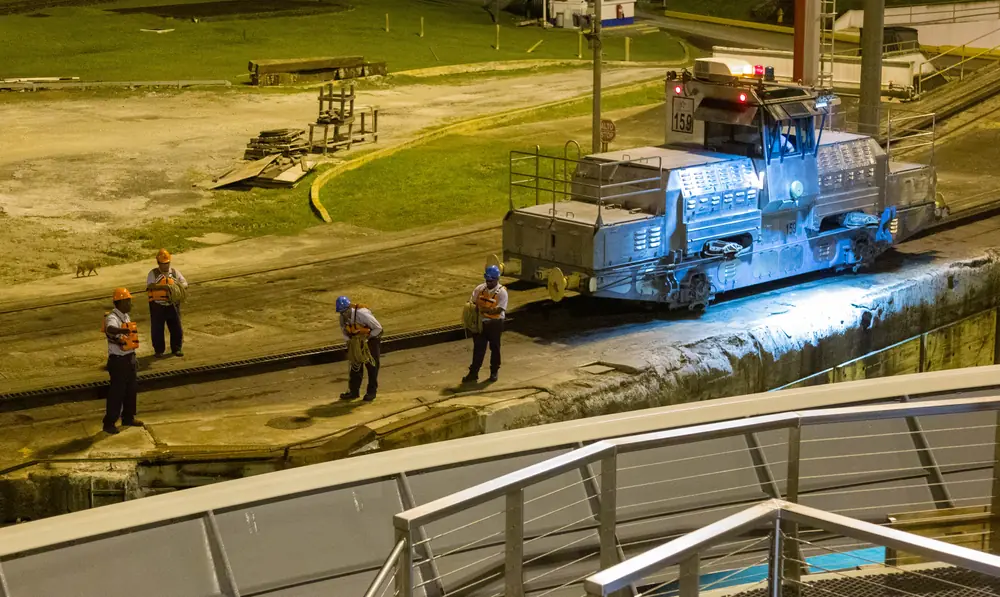
Canal workers get ready to cast lines to a ship at the Gatún Locks, Panama, 12 January 2020, 19:59. Photo: David Brossard, CC BY-SA 2.0.

Every rule counts midnight to 05:00 as night. The rest depends on the country.
EU law leaves the exact hours to each country, within one limit: night time is any period of at least seven hours that includes midnight to 05:00. You count as a night worker if at least three hours of your normal working day fall inside it.
Directive 2003/88/EC, article 2, points 3 and 4 (4 November 2003)- 7 hoursThe shortest night period EU law allows.Directive 2003/88/EC, article 2 (4 November 2003)
- 3 hoursOf normal daily work at night make you a night worker in the EU and the UK.Directive 2003/88/EC, article 2 (4 November 2003); GOV.UK, Night working hours (read 15 October 2026)
- More than 2 hoursOf the night period make a shift night work in Germany.Arbeitszeitgesetz §2, paragraph 4 (read 15 October 2026)
Where the night begins, rule by rule.
- France21:00 to 06:00. When no collective agreement sets the hoursCode du travail (France), article L3122-20 (as amended 10 August 2016)
- Germany, bakeries and pastry shops22:00 to 05:00Arbeitszeitgesetz §2, paragraph 3 (read 15 October 2026)
- United Kingdom23:00 to 06:00. Unless worker and employer agree in writing on another 7-hour period that includes midnight to 05:00GOV.UK, Night working hours (read 15 October 2026)
- Germany23:00 to 06:00Arbeitszeitgesetz §2, paragraph 3 (read 15 October 2026)
- France: press, radio, television, film, live shows and nightclubs00:00 to 07:00. When no collective agreement sets the hoursCode du travail (France), articles L3122-3 and L3122-20 (as amended 10 August 2016)
- European Union, the minimum00:00 to 05:00. Inside a night period of at least 7 hours that each country definesDirective 2003/88/EC, article 2 (4 November 2003)
- Window of circadian low, US flight crew rules02:00 to 05:59. A period of maximum sleepiness, not a legal night14 CFR 117.3, US flight crew duty rules (read 15 October 2026)
In France, a collective agreement can set other hours: at least nine consecutive hours that include midnight to 05:00, starting no earlier than 21:00 and ending no later than 07:00.
Code du travail (France), articles L3122-2 and L3122-20 (as amended 10 August 2016)The hours of maximum sleepiness, and the risks that come with them.
US flight crew rules call 02:00 to 05:59 the window of circadian low, a period of maximum sleepiness. The UK Health and Safety Executive found that the risk of errors, accidents and injuries is:
- higher on the night shift;
- rising with shift length over eight hours;
- increasing over successive shifts, especially night shifts;
- increasing when there are not enough breaks.
Its advice to employers: where possible, keep demanding, monotonous, dangerous or safety-critical work out of the night and the early morning, and consider more supervision in these hours of low alertness.
14 CFR 117.3, US flight crew duty rules (read 15 October 2026); Health and Safety Executive, Managing shift work (HSG256), paragraph 31, tables 4 and 12 (2006)A rota that is easier to live with.
The Health and Safety Executive's guidance for employers sets out good practice for shift schedules. Only a limited number of workers can successfully adapt to night work, it notes, so the design of the rota matters.
- Avoid permanent night shifts, and where possible offer a choice between permanent and rotating shifts.
- Rotate forward, from mornings to afternoons to nights, rather than backward.
- Rotate quickly, every 2 to 3 days, or slowly, every 3 to 4 weeks. Weekly or fortnightly rotation is the most disruptive.
- Keep night shifts, and demanding, monotonous, dangerous or safety-critical shifts, to 8 hours. Keep any shift to 12 hours at most, overtime included.
- On long shifts, nights and early starts, consider a limit of 2 or 3 in a row.
- When switching between day and night shifts, allow at least two nights of full sleep.
- Limit consecutive working days to 5 to 7, with enough rest between shifts, and build regular free weekends into the rota.
- Avoid starts before 07:00 unless the work needs them, and fit start and finish times to public transport.
- Encourage regular breaks away from the workstation.
Who works at night
of people in work in the European Union usually worked at night in 2025, and 7.4% sometimes did. The share runs from 1.3% in Lithuania to 10.8% in Slovakia.
Eurostat, Employed persons working at nights (lfsa_ewpnig), 2025 data (updated 10 September 2026)In the United States, 3% of wage and salary workers usually worked nights in 2024-25, and 15% worked outside daytime hours, a share that reaches 40% in leisure and hospitality and 25% in transportation and utilities.
U.S. Bureau of Labor Statistics, Job Flexibilities and Work Schedules 2024-25 (24 September 2026)Night shift work is most common in transport, health care, manufacturing and services such as social assistance, accommodation and food, information and communications, and travel and tourism.
IARC Monographs, volume 124: Night shift work (2020)- Slovakia10.8%
- Malta10.5%
- Finland6.7%
- Luxembourg6.4%
- Slovenia6.0%
- Romania5.4%
- Estonia5.2%
- Austria5.1%
- Ireland5.0%
- Portugal5.0%
- Greece4.5%
- Sweden4.5%
- Croatia4.3%
- Germany4.3%
- Italy4.2%
- European Union4.1%
- Hungary3.9%
- Latvia3.9%
- Czechia3.8%
- Denmark3.8%
- Belgium3.7%
- Netherlands2.7%
- Bulgaria2.6%
- Cyprus2.5%
- Poland1.7%
- Lithuania1.3%