
What the law owes you when you work nights.
Limits on hours, a free health check, a way back to day work, and pay: the rules for night workers in the EU, the UK, Germany and France, with the United States for contrast. Each answer names its article.
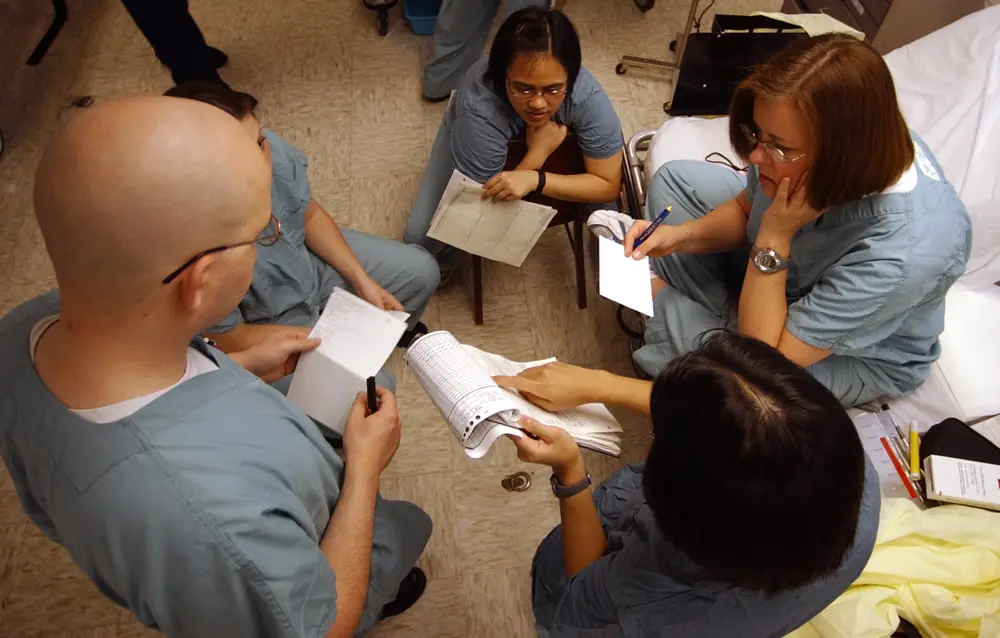
The intensive care night shift reads each patient's history before taking over, aboard the hospital ship USNS Comfort, 23 April 2003. Photo: Shane T. McCoy, U.S. Navy, public domain.
_night_shift_aboard_USNS_Comfort_(T-AH_20)_goes_over_the_history_of_each_patient.jpg)
Am I a night worker?
Most of these rights apply to night workers, not to everyone who sometimes works late. Each law draws the line its own way.
- EU
Yes if, as a normal course, at least three hours of your daily working time fall in the night period, or if you work at night a share of your yearly working time set by national law or collective agreement.
Directive 2003/88/EC, article 2, point 4 (4 November 2003)- UK
Yes if you regularly work at least three hours during the night period, or if a collective agreement says your work is night work.
GOV.UK, Night working hours (read 15 October 2026)- Germany
Yes if you normally work nights on alternating shifts, or work at night on at least 48 days in a calendar year. Night work means work covering more than two hours of the night period.
Arbeitszeitgesetz §2, paragraphs 4 and 5 (read 15 October 2026)- France
Yes if, at least twice a week on your usual schedule, you work at least three hours a day at night, or if you work at least 270 night hours over 12 consecutive months, unless a collective agreement sets another number.
Code du travail (France), articles L3122-5 and L3122-23 (as amended 10 August 2016)
How long can a night shift be?
8 hoursThe baseline for a night worker's day in the EU, the UK, Germany and France.
- EU
Normal hours may not exceed an average of 8 in any 24-hour period. Where the work involves special hazards or heavy physical or mental strain, 8 hours is the limit in any 24 hours in which you work at night.
Directive 2003/88/EC, article 8 (4 November 2003)- UK
An average of 8 hours in 24, usually worked out over 17 weeks, or up to 52 by agreement. Regular overtime counts, and you cannot opt out. Work with special hazards or mental or physical strain: no more than 8 hours in any 24.
GOV.UK, Night working hours (read 15 October 2026)- Germany
8 hours a working day, and up to 10 only if the average comes back to 8 within a calendar month or four weeks.
Arbeitszeitgesetz §6, paragraph 2 (read 15 October 2026)- France
8 hours a day, and 40 hours a week on average over 12 consecutive weeks, with exceptions set by collective agreement or authorised by the labour inspector.
Code du travail (France), articles L3122-6 (1 January 2018) and L3122-7 (10 August 2016)
Am I entitled to a free health check?
- EU
Yes: a free health assessment before you start nights and at regular intervals after, covered by medical confidentiality. It may be carried out within the national health system.
Directive 2003/88/EC, article 9 (4 November 2003)- UK
Your employer must offer a free health assessment before you become a night worker, and then regularly. You do not have to accept.
GOV.UK, Night working hours: health assessments (read 15 October 2026)- Germany
An occupational medical examination before you start, then every three years, and every year from the age of 50. The employer pays, unless it offers the examination free through a company doctor.
Arbeitszeitgesetz §6, paragraph 3 (read 15 October 2026)- France
Regular individual monitoring of your health, under the occupational health rules.
Code du travail (France), article L3122-11 (as amended 10 August 2016)
Can I move back to day work?
- EU
If you have health problems recognised as connected with night work, you are transferred, whenever possible, to day work you are suited to.
Directive 2003/88/EC, article 9 (4 November 2003)- UK
If a health professional confirms that night work has affected your health, your employer must find you other suitable work where possible. Employers cannot discriminate against a worker who does not want to work nights.
GOV.UK, Night working hours: health assessments (read 15 October 2026); GOV.UK, Night working hours (read 15 October 2026)- Germany
On request, your employer must move you to a suitable day job if an occupational doctor finds that night work endangers your health, if a child under 12 lives in your household and no one else there can look after them, or if you care for a seriously dependent relative whom no one else in the household can care for, unless urgent operational needs stand in the way.
Arbeitszeitgesetz §6, paragraph 4 (read 15 October 2026)- France
If the occupational physician finds that your health requires it, you are moved to a day job, for a time or for good. If night work cannot be reconciled with pressing family duties, such as looking after a child or a dependent person, refusing it is not misconduct or grounds for dismissal, and you can ask for a day job. You also have priority for day jobs in your category that come up.
Code du travail (France), articles L3122-12, L3122-13 and L3122-14 (as amended 10 August 2016)
Do I get paid more for working nights?
It depends on the country, and in some countries on your collective agreement.
- UK
Not by law. The National Minimum Wage applies to night workers, but there is no higher night rate.
GOV.UK, Night working hours (read 15 October 2026)- Germany
Yes. Unless a collective agreement already provides compensation, the employer must give a reasonable number of paid days off or a reasonable supplement on your gross pay for the hours you work at night.
Arbeitszeitgesetz §6, paragraph 5 (read 15 October 2026)- France
Not necessarily. The law guarantees compensatory rest; extra pay only where a collective agreement or your contract provides it.
Code du travail (France), article L3122-8 (as amended 10 August 2016)- United States
Not under federal law. The Fair Labor Standards Act does not require extra pay for night work: it is a matter of agreement between you, or your representative, and your employer. Covered, non-exempt workers are paid at least time and a half for hours over 40 in a workweek.
U.S. Department of Labor, Night work and shift work (read 16 October 2026)
General information, not legal advice.
These are the rules set by law. In France and Germany a collective agreement can replace several of the defaults above, so check yours, and for your own situation ask your trade union, your staff representatives or the labour inspectorate.
Code du travail (France), articles L3122-20 and L3122-23 (as amended 10 August 2016); Arbeitszeitgesetz §6, paragraph 5 (read 15 October 2026)